
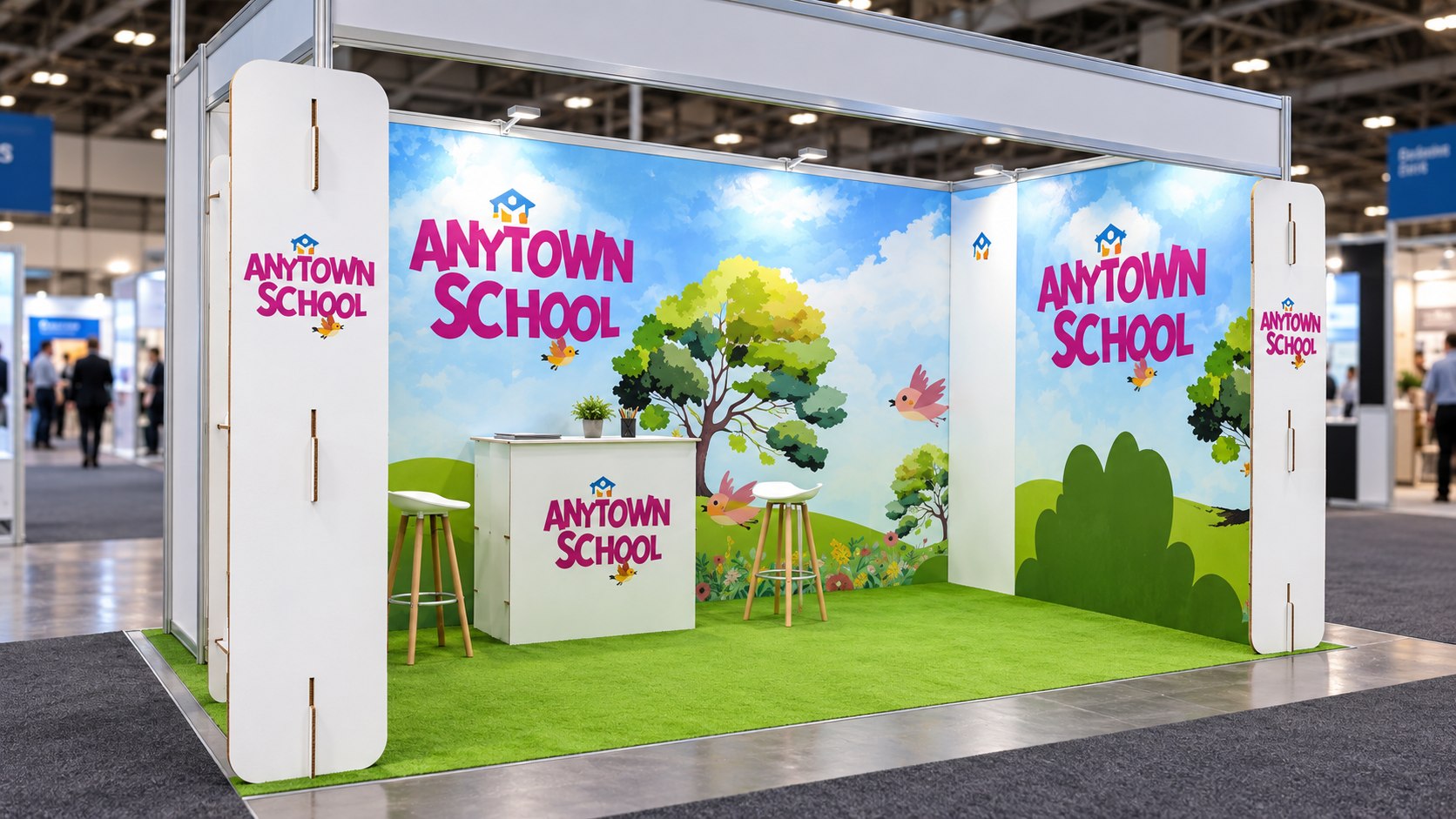
Shell Scheme Stands Explained: Sizes, Costs and How to Make Yours Stand Out
Quick answer: A shell scheme is a pre-built booth supplied by the show organiser, usually aluminium poles with infill panels, a fascia board carrying your company name, and often carpet and basic lighting. You get the shell; the inside is yours to fill. Standard UK sizes run from 2m x 2m up to 6m x 3m, with panel heights typically around 2.4m to 2.5m. EcoStands Green cardboard graphic packages for shell scheme spaces start at £627.20 ex VAT for a 2m peninsula and £1,467.20 ex VAT for a 3m x 2m corner, covering design, manufacture and transport.
Shell scheme is how most exhibitors start, and it is the option most often booked without anyone really explaining what it includes. The organiser sells you a stand, a structure appears, and you turn up on build day to find bare white panels, a fascia with your name spelled slightly wrong, and no idea what you are supposed to do with the space.
This guide covers what a shell scheme actually is, the standard sizes and what they cost, what the organiser gives you versus what you have to provide, and how to make a shell scheme stand look like a considered brand presence rather than a booked box.
What Is a Shell Scheme Stand?
A shell scheme is a modular booth structure provided by the show organiser as part of your stand booking. The organiser appoints a contractor who builds identical structures across the hall, and you occupy one of them.
A typical shell scheme package includes:
- The frame, usually aluminium poles at the corners and along the walls
- Infill panels, commonly white or grey laminate or foamex, roughly 1m wide each
- A fascia board across the open side or sides, carrying your company name and stand number in the show’s standard typeface
- Carpet, usually a standard cord in a colour the organiser has chosen
- Basic lighting, typically two or three spotlights on a track
- A single socket, sometimes, though this is frequently a paid extra
What it does not include is anything that makes it yours: graphics, furniture, product display, screens, storage, or additional power. That is the gap most first-time exhibitors underestimate.
Standard Shell Scheme Sizes
Shell scheme is sold by floor area, and the number of open sides matters as much as the square metreage because it changes how much wall you have to work with.
Configuration | Open sides | Wall panels available | Common sizes |
|---|---|---|---|
In-line | 1 | Back wall plus two side walls | 2m x 2m, 3m x 2m, 3m x 3m, 4m x 2m |
Corner | 2 | Two walls forming an L | 3m x 2m, 3m x 3m, 3m x 4m |
Peninsula | 3 | One back wall only | 2m to 8m frontage |
Island | 4 | None, or a central structure | Rare in shell scheme |
The counterintuitive point for a first-time exhibitor is that more open sides means less wall. A peninsula gives you far better visibility and footfall, but only one wall to communicate from. That changes the design problem completely, and it is why peninsula stands need a strong central vertical element rather than a big back wall message.
What Does a Shell Scheme Stand Cost?
There are two costs, and exhibitors routinely budget for only the first.
- The space itself, paid to the show organiser. This varies enormously by show and is usually quoted per square metre.
- Fitting it out, paid to whoever supplies your graphics, furniture and any extras. This is the part people forget.
Below are EcoStands Green’s published 2026 booth supply prices for cardboard shell scheme graphic packages. These cover design, manufacture and transport to a UK venue. All prices ex VAT.
Configuration | Size | Price (ex VAT) |
|---|---|---|
Peninsula, 3 open sides | 2m | £627.20 |
Peninsula, 3 open sides | 3m | £907.20 |
Peninsula, 3 open sides | 4m | £1,539.20 |
Peninsula, 3 open sides | 6m | £2,451.20 |
Corner, 2 open sides | 3m x 2m | £1,467.20 |
Corner, 2 open sides | 3m x 3m | £1,747.20 |
Corner, 2 open sides | 3m x 4m | £2,043.20 |
In-line, 1 open side | 3m x 2m | £2,027.20 |
In-line, 1 open side | 3m x 3m | £2,587.20 |
In-line, 1 open side | 3m x 4m | £2,867.20 |
Not included: venue services such as electrics and internet, flooring, TV and AV equipment, and furniture. A turn-key installation service is available as an add-on, priced per show.
At the end of the show, cardboard graphics go into the venue’s standard paper recycling stream. No skip charge and no specialist waste contractor, which is a genuine cost saving as well as an environmental one. Conventional foamex or PVC panels are general waste and frequently chargeable.
Lead Times
For a cardboard shell scheme graphics package, allow two to four weeks from artwork sign-off to delivery. That breaks down roughly as:
- Design and artwork: 3 to 7 working days depending on how much you supply
- Amends and sign-off: however long your approvals take, which is usually the variable that slips
- Print and manufacture: 5 to 7 working days
- Transport to venue: 1 to 2 days
Book earlier than you think you need to. The bottleneck is almost never production, it is internal sign-off, and shows do not move their dates to accommodate it.
How to Make a Shell Scheme Stand Out
The defining problem of shell scheme is that everyone in the hall has the same box. Five things genuinely differentiate one.
1. Cover the panels completely
The single biggest upgrade is full-height, full-width graphics across every available wall. Part-covered panels with visible white gaps read as unfinished. Full coverage reads as a designed stand, and it costs less than most people assume.
2. Go dark
Shell scheme halls are a sea of white and light grey. A predominantly dark stand is more visible from down the aisle than another bright one, because contrast beats brightness in a visually loud environment.
3. Build something vertical
Everything below roughly 1.8m is hidden behind people once the hall is busy. Anything you can do to add height within the organiser’s limit buys you visibility. Check the permitted height first, as shell scheme is usually capped at panel height.
4. Give people a reason to stop
A demonstration, a screen, or a physical object worth picking up converts a glance into a conversation. Our guide to using 3D creative objects to boost dwell time covers this in more detail.
5. Say one thing, in big type
Your headline needs to be readable from four metres away. Most shell scheme graphics carry far too much copy at far too small a size, which means visitors read none of it. Six words beats thirty.
For the fuller treatment, see sustainable exhibition stand design: eight principles for visual impact.
Shell Scheme or Space Only?
Shell scheme | Space only | |
|---|---|---|
What you book | A pre-built booth | Bare floor |
Structure | Organiser’s contractor | Yours to design and build |
Design freedom | Limited to the inside of the box | Full, within venue rules |
Typical footprint | Up to about 18m² | 18m² and upwards |
Total cost | Lower | Higher |
Best for | First shows, smaller budgets, testing a market | Established programmes, larger footprints, hero presence |
A reasonable rule: stay in shell scheme until the limitations of the box are actively costing you, then move to space only. Converting mid-programme is common and most organisers will quote both. See our Eco Space Only Packages if you are weighing up the step up.
Frequently Asked Questions
Next Steps
Send us your stand size, the number of open sides and the show, and we will come back within one working day with a design direction and a fixed price. Request a brief from EcoStands Green.
- Eco Shell Scheme Packages: fixed price cardboard graphics for shell scheme spaces
- Eco Space Only Packages: turnkey builds if you are stepping up from shell scheme
- UK Exhibition Venues: venue build requirements and access notes
Related Reading
- Sustainable Exhibition Stand Design: 8 Principles for Visual Impact
- Eco-Friendly Exhibition Stands: The 2026 Buyer’s Guide
- Cardboard Exhibition Stands Explained: Strength, Cost and Sustainability
- Eco Conference Stands: Lightweight Sustainable Builds for Single-Day Events
- Sustainable Exhibition Stands for UK Venues