
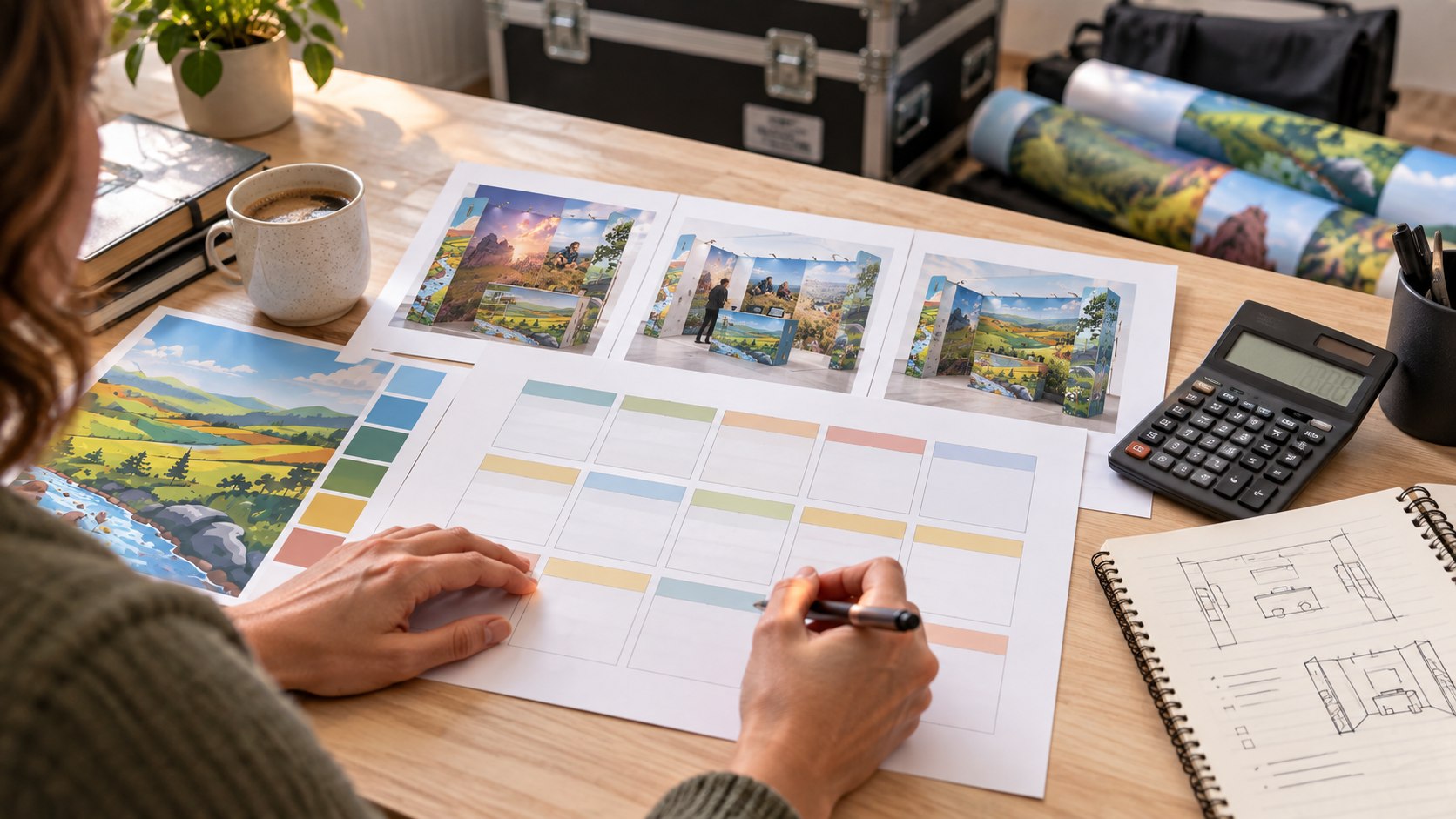
Planning Your 2027 Exhibition Programme: A Sustainable Budgeting Guide
Quick answer: Plan a year of exhibiting by deciding the full show calendar first, then choosing one stand strategy across all of it rather than costing each show separately. The number that drives everything is how many times a single stand will be deployed: one to three shows favours recyclable cardboard, three to six favours a refurbishable hybrid, six or more favours reusable modular. Budget the stand at roughly 25 to 40% of total show cost, and leave a contingency for venue services, which is where budgets most often break.
Exhibition budgets get set in the last quarter of the year, usually by someone assembling last year's invoices and adding a bit. It is the wrong method, and it produces the same three errors every time: the stand is costed per show rather than per programme, venue services are underestimated, and sustainability requirements arrive as a surprise in March.
This is a framework for doing it properly, written for the point in the year when you are actually doing it.
Start With the Calendar, Not the Stand
The most common planning mistake is treating each show as a separate project. It leads to buying a new stand for a show you could have covered with an existing one, or buying an expensive reusable system for a calendar that will never justify it.
Before costing anything, write down every show you intend to attend in 2027 with four columns:
- Date and venue, because access and build windows vary enormously between purpose built halls and converted venues
- Stand size and number of open sides, since open sides change both design and cost more than floor area does
- Audience, because a trade show, a conference and a consumer event need different things
- Whether the messaging will be the same as the previous show, which is the question that determines your whole stand strategy
That last column is the one people skip and the one that matters most.
The One Decision That Sets Your Budget
How many times will a single stand actually be deployed across the year? Answer honestly rather than aspirationally, and the strategy follows.
Deployments in 2027 | Strategy | What you budget for |
|---|---|---|
1 to 3 | Recyclable cardboard, new build each time or lightly reused | Per-show build cost, no storage, no return transport |
3 to 6 | Refurbishable: durable core, graphics replaced per show | Higher initial build, then a refresh cost per show, plus storage |
6 or more | Reusable modular system | High capital cost year one, then graphics and logistics only, plus storage and maintenance |
Three sanity checks before you commit to the higher-investment options. Will your brand positioning survive unchanged through 2027? Do you have storage, or will you be renting it? Is there a named person responsible for retrieving and redeploying components between shows? If any answer is no, revise the number down.
The full version of this decision, including cost per deployment worked through, is in Reusable vs Recyclable vs Refurbishable: An Exhibitor's Decision Tree.
The Budget Lines People Forget
A realistic exhibition budget has considerably more lines than most spreadsheets carry. The stand is usually 25 to 40% of the total.
Line | Typically budgeted? | Note |
|---|---|---|
Floor space | Yes | Paid to the organiser, quoted per square metre |
Stand build or graphics | Yes | 25 to 40% of total programme cost |
Venue services | Often not | Electrics, internet, rigging, water. The most common overrun |
Furniture | Sometimes | Hire or buy, rarely included in stand quotes |
Flooring | Sometimes | Not included in shell scheme upgrades or most build quotes |
AV and screens | Sometimes | Hire cost plus the power to run it |
Transport and logistics | Yes | Lower for flat pack, doubled for anything returning to storage |
Installation | Sometimes | Turn-key install is usually an add-on, priced per show |
Storage between shows | Often not | Only applies to reusable and refurbishable strategies |
Staff travel and accommodation | Yes | Frequently the largest single line after space |
Collateral and giveaways | Yes | |
Waste disposal | Rarely | Chargeable for timber and MDF builds; avoided entirely with cardboard |
The three bolded lines are where budgets break. Venue services in particular are ordered late, priced at a premium for late orders, and almost never estimated properly in advance. Get the exhibitor manual early and price the electrics before you set the budget, not after.
Indicative Stand Costs for 2027 Planning
For budgeting purposes, EcoStands Green's published 2026 booth supply prices for cardboard stands, ex VAT, covering design, manufacture and transport to a UK venue:
Size | 1 open side | 2 open sides |
|---|---|---|
3m x 2m | £2,027.20 | £1,467.20 |
3m x 3m | £2,587.20 | £1,747.20 |
3m x 4m | £2,867.20 | £2,043.20 |
3m x 5m | £3,499.20 | £2,659.20 |
6m x 6m | n/a | £4,131.20 |
For refurbishable and reusable strategies, indicative UK market ranges are £8,000 to £18,000 for a 3m x 3m FSC plywood and cardboard hybrid, and £10,000 to £22,000 for a 3m x 3m recycled aluminium modular system. EcoStands Green specialises in cardboard; for those builds our parent company Expositionists delivers across the UK and Europe.
Budget for the Sustainability Requirements Now
Three things are landing on exhibition programmes that were not there a few years ago, and all three are easier to budget for in October than to react to in March.
- Venue sustainability requirements. Major UK venues publish waste and landfill diversion expectations, and some now charge for stand waste removal. A cardboard build removes that line entirely because it goes into the venue's paper recycling.
- Your own ESG reporting. If your organisation reports Scope 3 emissions, exhibition activity sits inside that. Ask your stand supplier for an embodied carbon figure with a stated methodology at quote stage, not at year end.
- Procurement and tender requirements. Increasingly your own clients will ask what your event programme's footprint is. Having a documented answer is a commercial asset, not just a compliance one.
None of this needs to increase your budget. For single-use and short-run stands, cardboard is typically cheaper than the conventional equivalent because it weighs less to ship, builds without tools, and avoids disposal charges. The saving is real, but only if you specify it at planning stage rather than bolting it on.
A Sensible Planning Timeline
- October to November: lock the show calendar, decide the stand strategy, set the budget with all the lines above.
- December to January: book space for the first half of the year. Early booking usually gets better positions as well as better rates.
- Eight to ten weeks before each show: brief the stand, download the current exhibitor manual, confirm height limits and build windows.
- Six weeks before: artwork sign-off. This is the deadline that slips most often.
- Four weeks before: order venue services. Late orders carry premiums, sometimes substantial ones.
- Two weeks before: confirm logistics, access route and install arrangements.
Frequently Asked Questions
How much of an exhibition budget should the stand be?
Typically 25 to 40% of total programme cost. The other major lines are floor space paid to the organiser, staff travel and accommodation, venue services such as electrics and internet, furniture, flooring, AV, transport and collateral. Stand cost as a proportion falls as footprint grows, because space and staffing scale faster than build cost does.
When should I plan next year's exhibition programme?
Lock the show calendar and stand strategy in October and November, then book space for the first half of the year in December and January. Early space booking usually secures better stand positions as well as better rates. Individual show preparation should start eight to ten weeks out, with artwork signed off six weeks before and venue services ordered four weeks before to avoid late-order premiums.
What gets missed most often in exhibition budgets?
Three lines: venue services such as electrics, internet and rigging, which are ordered late and priced at a premium; storage between shows, which only applies if you have chosen a reusable or refurbishable stand; and waste disposal, which is chargeable for timber and MDF builds. Cardboard builds avoid the disposal line entirely because they go into the venue's paper recycling stream.
Is it cheaper to buy one reusable stand or a new stand each show?
It depends entirely on how many times you will actually deploy it. Below roughly six deployments, a recyclable cardboard build each time is cheaper and lower carbon, because a reusable system adds high upfront cost, return transport, storage and maintenance. At six or more deployments the reusable system becomes cheaper per show. Be realistic about the number, since the most expensive mistake in exhibiting is buying a reusable stand and then not reusing it.
How do I budget for exhibition sustainability requirements?
Budget for three things: venue waste and landfill diversion requirements, which cardboard builds avoid because they use the venue's paper recycling stream; an embodied carbon figure from your stand supplier for Scope 3 reporting, which should be requested at quote stage; and any procurement or tender evidence your own clients require. For single-use and short-run stands this usually reduces rather than increases cost, provided it is specified at planning stage.
How far in advance should I order a cardboard exhibition stand?
Allow two to four weeks from artwork sign-off to delivery for a shell scheme graphics package, and four to six weeks for a space only build. Brief the supplier eight to ten weeks before the show to allow for design, amends and internal approval. The most common cause of delay is internal artwork sign-off rather than production capacity.
Next Steps
If you are costing a 2027 programme now, send us the show list with sizes and open sides and we will come back within one working day with indicative costs across the whole calendar, plus which stand strategy fits it. Request a sustainability brief from EcoStands Green.
- Eco Shell Scheme Packages: fixed price cardboard graphics for shell scheme spaces
- Eco Space Only Packages: turnkey builds for space only footprints
- Bespoke and Custom Built Ecostands: fully custom design and build