
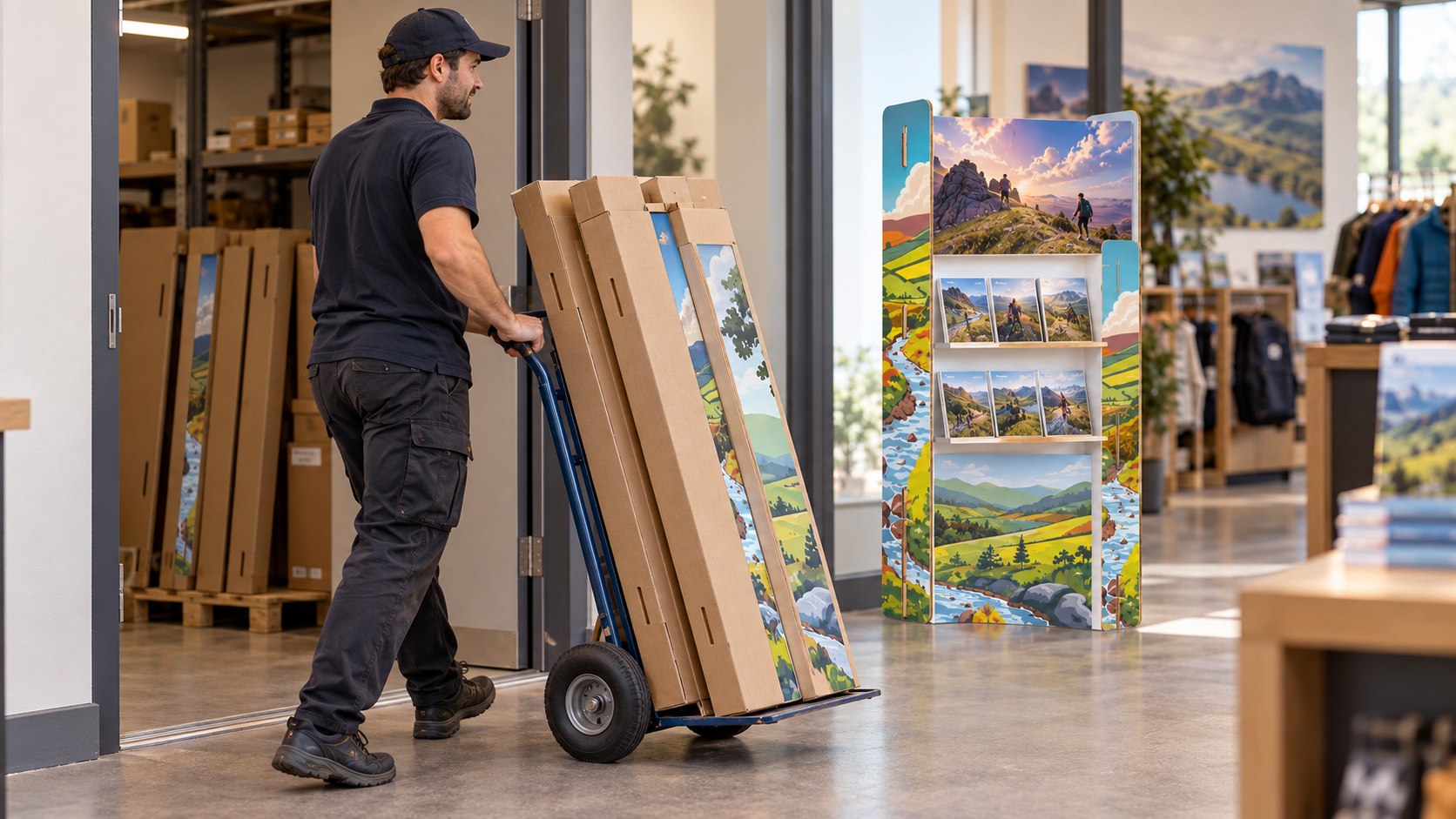
Designing for the “Last Mile”: Reducing Transport Emissions with Flat-Pack POS
In the world of retail and exhibitions, logistics is often the hidden giant of environmental impact. While choosing a sustainable material is a vital first step, how that material gets from the factory to the venue or store floor can make or break your carbon footprint.
At EcoStands Green, we believe that true sustainability must be built into the engineering of the product itself. By designing our Point of Sale (POS) and exhibition products to be entirely flat-packable, we are helping brands conquer the “last mile” of their supply chain by reducing both transport emissions and operational costs.
- The Carbon Cost of “Shipping Air”
Traditional retail displays and exhibition stands are often bulky, heavy, and difficult to transport. When items are shipped pre-assembled or made from heavy timber and metal, vehicles reach their volume capacity long before they reach their weight limit. This means you are essentially paying and emitting carbon to ship empty air.
Flat-pack design solves this by ensuring every cubic centimetre of a vehicle is utilised. Our cardboard units fold down into slim, protective outers. This allowing up to 80% more units to be stacked on a single pallet compared to traditional builds.
- Lightweight Materials, Lower Emissions
The math is simple: the heavier the vehicle, the more fuel it consumes. Cardboard exhibition stands and POS units weigh a mere fraction of their MDF or plastic counterparts. By stripping away unnecessary weight, we lower the energy requirements for every mile travelled. This lightweight nature does not just benefit the planet. It also reduces the need for heavy-duty manual handling and specialist machinery on-site.
- No Specialist Tools, No Specialist Teams
One of the primary benefits of “slot and tab” engineering is simplicity. Because our creative objects and shelving units are designed to be intuitive, store staff or event teams can assemble them in minutes without the need for specialist build crews or power tools. This removes the requirement for secondary installation vehicles to visit a site, which further cuts the carbon footprint of your rollout.
- Financial ROI: Designing for the Bottom Line
Sustainability and profitability can go hand in hand. Reducing your vehicle requirements does not just save carbon emissions. It directly slashes your logistics budget. Fewer vehicles mean lower fuel surcharges, reduced driver hours, and smaller storage fees between events. For national retail rollouts or multi-city exhibition tours, these savings amortise quickly. This proves that smart design is the most cost-effective way to exhibit.
- Closing the Loop Locally
Because our products are 100% recyclable, the logistics of the “return journey” are simplified. Instead of shipping used displays back to a central warehouse or a specialist disposal site, they can be flat-packed and recycled via standard paper streams right at the venue or store. This eliminates the emissions associated with waste transport and skip hire.
Smart Logistics for a Greener Future
Transport is a major contributor to global emissions, but it is a challenge we can meet with better design. By choosing lightweight, flat-packable cardboard solutions, you are building a cleaner and more efficient supply chain from start to finish.
Ready to streamline your logistics? Talk to the EcoStands Green team and let’s plan a sustainable rollout that saves you money and carbon.